What is Feminine energy ? The Truth
Hello Everyone ! What is Feminine energy ? It’s become a buzzword online, but not always in the best way. Some self-proclaimed love coaches use it to suggest that women are to blame for unhappy relationships, especially if they show traits like being independent or assertive.
According to them, that’s “masculine energy” that supposedly emasculates men.
At the same time, we’re seeing a wave of “tradwife” content, where women celebrate traditional roles like homemaking, raising children and supporting a breadwinning husband. While there’s nothing wrong with choosing that lifestyle, the way it’s promoted often draws criticism from feminist voices.
1. What is feminine energy according to the patriarchal society ?
A. The “Trad Wife” Narrative
Feminine energy is often criticized because it is often associated to the “trad wife” narrative. When people talk about feminine energy, they are usually referring to the idealized image of women from the mid-20th century, particularly in the post-World War II era. Specifically, this image portrays women as: docile, nurturing and entirely devoted to their husbands and children.
However, this idealized woman is a fantasy and does not define at all femininity for several reasons, historically the trad wife lifestyle was far from universal :
- most working-class households, women have always worked outside the home: whether on farms, in factories or in other jobs to help support their families.
- being a “trad wife” was a privilege largely reserved for wealthier families who could afford to have one partner stay home.
B. Is the trad wife an expression of feminine energy
The problem with trad wife content is whenit weaponizes this lifestyle not as one of many valid choices, but as the ultimate expression of femininity. While not all individuals who identify as trad wives may intentionally devalue other women’s choices, the movement as a whole often promotes a very narrow and idealized version of femininity. Consequently, this narrative implicitly undermines the femininity of women who choose different paths, such as pursuing careers, education or other personal goals.
Additionally, the trad wife aesthetic often packages great values like: self-sufficiency, authenticity and a return to simpler living but within a rigid framework that centers entirely on serving a traditional gender hierarchy. This reduces a woman’s identity to her domestic role, leaving little room for individuality, outside interests or personal growth. Rarely do they mention hobbies, friendships or passions that exist independently of their husbands or beyond the home.
Furthermore, it also raises questions about the intent behind promoting this content, especially given that it romanticizes a time when the original trad wife archetype had limited rights and opportunities beyond dedicating their lives to their husbands and households.
So what is Feminine Energy ?
2. Feminine vs Masculine energies: A Taoist origin
The idea of feminine energy didn’t start with Instagram trends or 1950s housewives. It actually goes way back, all the way to Taoist philosophy in ancient China (around the 3rd century BCE).
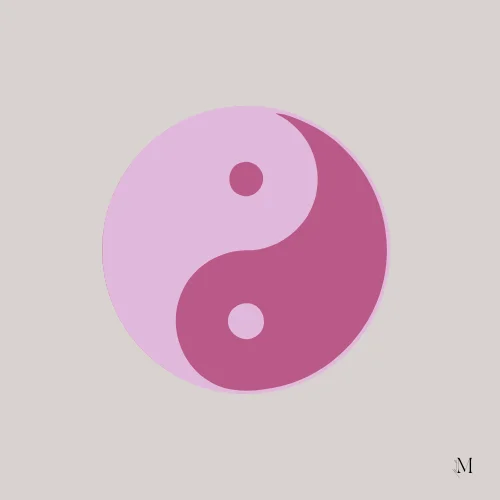
In Taoism feminine energy is represented by yin energy, while masculine energy is represented by yang energy. (See illustration on the left.)
The Feminine Energy or Yin is associated to :
- Dark
- Feminity
- Wisdom
- Feelings
- Moon
- Cold
- Receptivity
The Masculine Energy or Yang is associated to:
- Light
- Masculinity
- Action
- Heat
- Sun
- Movement
- Competition
The Yin and Yang symbol represents the interconnectedness of opposing forces, not just externally in the universe, but also within us. These forces, often described as feminine and masculine energies, are not strictly male or female. Rather, they are complementary aspects present in everyone. The small dot within each section symbolizes that the world isn’t always black and white.
A man can express feminine energy and a woman can lean into masculine energy and that balance is what makes us whole.
3. Qualities associated to the Feminine and Masculine energies
Yin or Feminine energy qualities are:
- creativity
- healing
- listener
- introspection
- intuition
- wisdom
- emotional intelligence
- compassion
- gentleness
- devotion
- calm
- collaboration
- reception
Yang or Masculine energy qualities are:
- responsability
- action
- giving
- power
- strength
- focus
- generosity
- abundance
- control
- protection
- intellect
- assertive
The masculine and feminine energy within us can vary throughout our lives depending on the challenges, external influences, responsabilities and roles we take on ( such as caregiver, leader or entrepreneur).
Moreover it’s believed that balancing feminine and masculine energy within ourselves can promote a healthy flow of energy, which may contribute to good health. Staying too long in a single energetic state might be less beneficial.
Finally, the “trad wife” trend appears like another attempt by the patriarchy to change the narrative about the concept of “Feminine Energy.” By diminishing a woman’s role to solely nurturing seems restrictive because it can lead to financial dependence and potential control. As mentioned above, being in your feminine energy is much more than being nurturing and being a women is so much more than just being in your feminine energy. Women have the power to create life, to create their own lives.
In my next article I explained how to boost your feminine energy.